Choosing a direction in the professional world often feels like standing at a massive crossroads. In the world of finance and accounting, two of the most recognized landmarks are the CPA and the CFA. While both credentials carry immense weight, they lead to different destinations. Whether you just cleared your final CPA exam or recently received your results for the CFA Level 1, your professional life is about to shift gears.
Navigating these choices requires a clear look at what these milestones actually represent. One leans toward the health of a business’s internal numbers, while the other looks outward at markets and investments. Both offer high earning potential, but the daily rhythm of the work varies significantly.
Career Routes Following a CPA Certification
Earning a CPA license makes you a trusted advisor in the eyes of the public and the government. This designation isn’t just about taxes; it’s a versatile tool that fits into almost any business structure.
Public Accounting and Auditing
The most common starting point for a newly minted CPA is a public accounting firm. Here, you serve various clients, ensuring their financial records match reality. Auditing is a staple of this path. You verify that companies follow legal standards, providing the transparency that investors rely on. This role builds a strong foundation because you see the inner workings of many different industries in a short time.
Corporate Finance and Management Accounting
If you prefer sticking with one team, moving into a corporate role is a logical step. Large companies need CPAs to handle their internal financial reporting. You might start as a senior accountant and move toward becoming a controller or even a CFO. In this setting, you help the leadership team make decisions based on budget trends and cost analysis. You become the person who keeps the company’s financial engine running smoothly.
Forensic Accounting
Forensic accounting puts you at the center of financial investigations. You partner with police or lawyers to catch people stealing money or hiding assets through tax evasion. Instead of a magnifying glass, you use bank statements and ledger entries to find proof of fraud. Holding a CPA certification gives you the standing to speak as an expert in front of a judge or jury.
Tax Consultancy
Instead of just reacting to tax season, you act as a year-round consultant. You look at a company’s goals and map out a path that minimizes what they owe legally, ensuring their cash stays within the business for growth.
Career Prospects After Passing CFA Level 1
Passing the first level of the CFA program is a signal to the industry that you possess a baseline of technical knowledge in investment tools and ethical standards. While it isn’t a full charter, it opens doors that are usually closed to general graduates.
Equity Research Assistant
Many people use their success in the CFA Level 1 to land a spot in equity research. You’ll assist senior analysts in studying stocks and industries. Your day consists of building financial models and writing reports that recommend whether to buy, sell, or hold a particular security. It’s a high-pressure environment that rewards deep curiosity and the ability to spot trends before they become obvious.
Investment Banking Analyst
The “Level 1” badge on your resume shows investment banks that you have the stamina for their rigorous workload. In this role, you help with mergers, acquisitions, and initial public offerings (IPOs). The work involves a lot of valuation exercises and preparing “pitch books” for clients. It’s a fast-paced world where you learn how massive deals get structured.
Portfolio Management Support
Portfolio managers hire those with a CFA level 1 pass to handle the heavy lifting of data tracking. You record how different assets move and keep an eye on fund performance. Even without the final say on big trades, you see exactly how veterans stay calm and find gains when the market gets messy.
Risk Management
Banks and hedge funds need people who can quantify danger. With the grounding in derivatives and quantitative methods from your studies, you can enter risk management departments. Here, you calculate the “Value at Risk” (VaR) and ensure the firm doesn’t take on more debt or exposure than it can handle. It’s a specialized field that has become increasingly vital in the modern economy.
Comparing the Two Paths
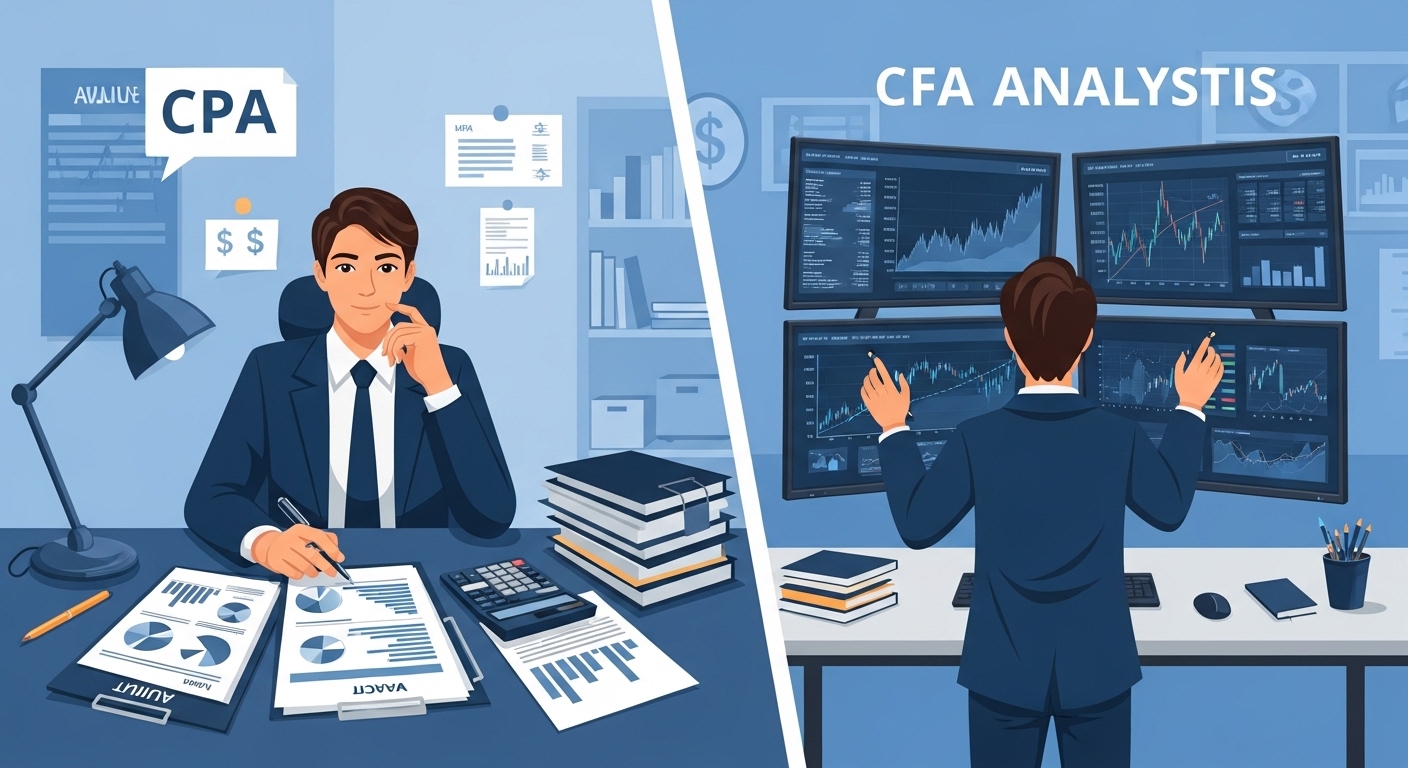
Picking a career track depends on whether you prefer CFA Level 1 with a CPA certification or betting on what happens next in the markets.
● CPAs focus on what has already happened. They record, report, and verify financial history to ensure everything is accurate and legal.
● CFA Level 1 candidates are looking at what will happen. They analyze data to predict future market movements and value assets that don’t exist yet.
Salary and Growth
Think about how you want to get paid. A CPA certification offers a predictable path to a wealthy retirement through steady promotions. Investment careers trade that stability for the chance of giant bonuses based on how well you manage money. This suits anyone who wants their paycheck to reflect their daily wins on the trading floor.
Work-Life Balance
Public accounting is known for its “busy season” (usually January through April), where hours are long, but the rest of the year is more manageable. Investment roles, particularly in banking or research, tend to demand long hours year-round, especially when markets are active or deals are closing.
Blending the Two: CFA & CPA
It’s worth noting that these two paths aren’t mutually exclusive. Some professionals earn a CPA first to master the “language of business” and then pursue the CFA to pivot into investment banking or private equity. Having both makes you a powerhouse. You can read a balance sheet with the precision of an auditor while valuing a company with the insight of an analyst.
For those looking to start their journey, Zell Education provides the structured environment needed to tackle these rigorous exams. Having a mentor or a dedicated curriculum can make the difference between a passing grade and a retake.
Whatever you choose, the key is to start moving. The financial world rewards those who specialize. Whether you want to be the person who ensures the books are clean or the person who picks the next big stock, your certification is the first step toward a lifelong career.