
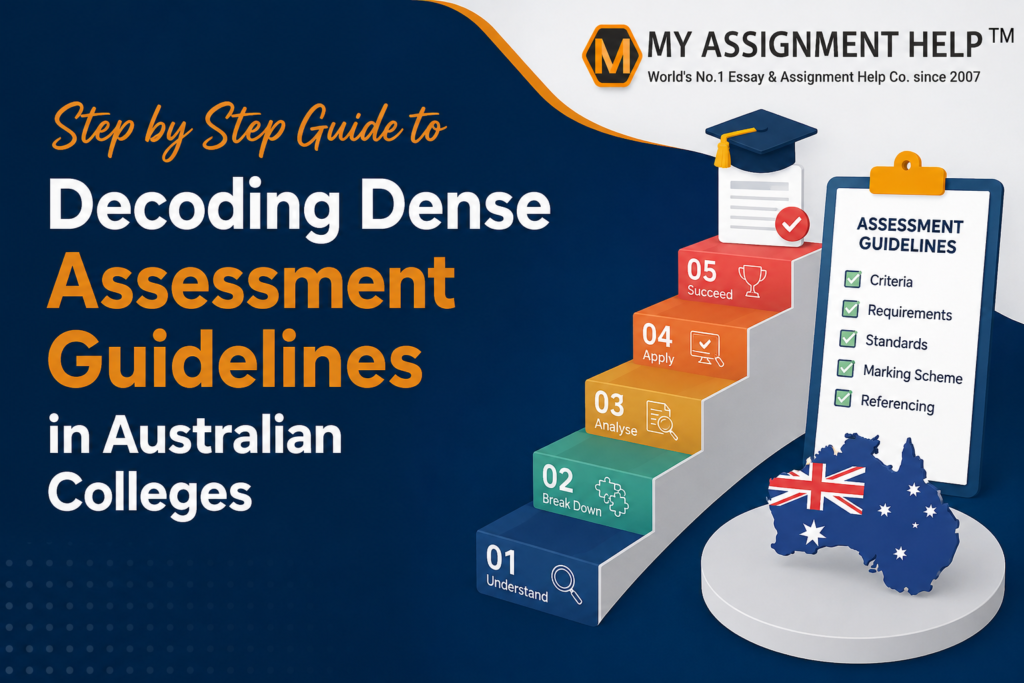
Stepping into an Australian college lecture theatre is an exciting milestone. Yet, the first major hurdle many students face is not the exams. It is the massive pack of paperwork that arrives with every task. Australian higher education institutions are famous for their incredibly thorough, detailed task sheets. These documents are designed to meet strict national quality standards. However, to a new student, they can look like an endless wall of confusing text.
When you sit down with a fresh task brief, it is easy to feel stuck. You might see pages of complex language, long lists of goals, and strict rules about formatting. This guide will break down that wall of words. We will show you how to pull out the hidden instructions so you can build a perfect plan for your papers.
Understanding Why Briefs Are So Long
Before we look at the steps, we need to know why these documents are so dense. Higher education in Australia is governed by a body called the Tertiary Education Quality Standards Agency (TEQSA). This group makes sure every university and college teaches at a high level. Because of this, professors cannot just say, “Write five pages on business trends.” They must prove exactly how your work tests specific skills.
TEQSA
This leaves you with a document that mixes basic instructions with deep academic goals. If you want to keep your head above water, using an online assignment writing service can help you see clear examples of well-structured work. Seeing a clean template makes it much easier to spot what your own professors are looking for when they write these long briefs.
Step 1: Scan for the Critical Constraints
Do not try to read the whole document line by line on your first go. Your first job is to hunt down the hard limits. These are the fixed rules that you cannot change. If you break them, you will lose marks before the teacher even reads your arguments.
Look for these three things first:
- The Due Date and Time: Check the exact time zone. Australian states use different daylight saving schedules, which can trip up distance learners.
- The Word Count Limits: Check if the limit includes your reference list, in-text citations, or appendices. Most Australian schools give you a 10% cushion above or below the target number.
- The Weighting: Is this task worth 10% or 50% of your total grade? This tells you how much time and research energy you should spend on it.
Highlight these facts in bright yellow right at the top of your page. They form the boundaries of your entire project.
Step 2: Uncover the Core Action Verbs
Every task sheet has a specific command hidden inside it. Your lecturers use explicit action verbs to tell you how to handle the data. If you miss the meaning of these verbs, you might write an excellent summary when the teacher actually wanted a deep critique.
| Verb | What the Lecturer Actually Wants |
| Critique / Evaluate | Do not just describe. Show the strengths and weaknesses, and back it up with evidence. |
| Analyse | Break the topic into parts. Explain how these pieces connect and why they matter. |
| Compare and Contrast | Find the hidden links and clear differences between two theories or cases. |
| Justify | Give strong academic reasons for your choices or conclusions to defend your view. |
Circle these verbs. They tell you exactly what kind of thinking you need to show in your writing.
Step 3: Strip Away the Institutional Noise
A large part of your document is made of standard college policies. While these rules are highly important, they are usually identical across all your subjects. To avoid feeling overwhelmed, you need to separate this boilerplate text from your unique task directions.
Look for sections about generic plagiarism rules, campus health services, extensions, and late penalty calculations. Once you know the baseline rules, mental or physical separation of these pages lets you focus entirely on the actual prompt. This keeps your mind clear so you can map out your paragraphs without getting distracted by blocks of legal text.
Step 4: Deconstruct the Marking Rubric
The marking rubric is your ultimate cheat code. It is a grid that shows exactly how your teacher will hand out points. Many students make the mistake of only reading the task description, but the rubric is where the real secrets live.
Look closely at the “High Distinction” (HD) column. Do not just look at the passing criteria. If the rubric says an HD requires “deep integration of peer-reviewed journals,” you know that relying on basic websites will cap your mark. If it awards 30% of the grade for structure, you must spend a lot of time organizing your headers. Map your outline to match the rows of the rubric.
Step 5: Build an Assignment Skeleton
Now that you have your constraints, verbs, and rubric goals, you can build your structural skeleton. Do not start writing full sentences yet. Instead, map out the word counts for each section based on the weights given in your prompt.
For a standard 2,000-word business or tech report, your plan might look like this:
- Introduction (10%): Around 200 words setting up the context and your main thesis statement.
- Body Paragraphs (80%): Around 1,600 words broken into 4 or 5 thematic areas. If a specific section needs sql assignment help because it requires designing database schemas or writing clean queries, you should set aside a dedicated block of 400 words just to explain that technical architecture clearly.
- Conclusion (10%): Around 200 words bringing your ideas together without adding new facts.
Step 6: Verify the Referencing Style
Australian colleges are incredibly strict about citations. Getting the style wrong can trigger academic integrity warnings or lead to a heavy drop in marks.
Check your brief to see which guide your department uses. The most common styles in Australia are:
- Harvard (APA 7th or AGPS style): Common in business, humanities, and social sciences.
- IEEE: The standard format for engineering and complex computing courses.
- AGLC (Australian Guide to Legal Citation): Used exclusively for law papers.
Once you find the required style, open your library’s reference portal and keep the style guide open in a side window while you draft your work.
About the Author
Jack Thomas is a Senior Academic Consultant at myassignmenthelp. With over nine years of experience helping students navigate the Australian higher education system, Jack specializes in breaking down complex curriculum guidelines into clear, actionable study patterns. When he isn’t reviewing academic frameworks or building student toolkits, Jack can be found hiking through the national parks of Western Australia or volunteering as a youth mentor in local community sports programs.
Frequently Asked Questions
What happens if the word count on my task sheet matches the rubric but conflicts with the unit outline?
Always email your unit coordinator immediately for clarification if you spot a mismatch. Usually, the specific task brief takes priority over a general course outline, but getting confirmation in writing saves you from unexpected late penalties.
Can I include charts and code snippets in my main word count?
In most Australian colleges, calculations, diagrams, raw data tables, and programming code are excluded from the final word count. However, you must always double-check the “appendices and exclusions” section of your specific document to be absolutely sure.
Why do Australian professors focus so heavily on the marking rubric?
Rubrics guarantee that grading stays fair and consistent across hundreds of students. By following the rubric closely, you ensure that your marker can easily check off every required skill as they read your paper.
What should I do if a task brief uses a term I have never seen before?
Look up the word in your university library’s academic glossary or your weekly lecture slides. Professors often use specific terms from your weekly readings directly inside the assessment prompts.
Is it acceptable to use older textbooks for my reference list?
Australian higher education values current data. Try to find peer-reviewed journal articles and books published within the last five years, unless you are discussing a classic, fundamental theory.
