
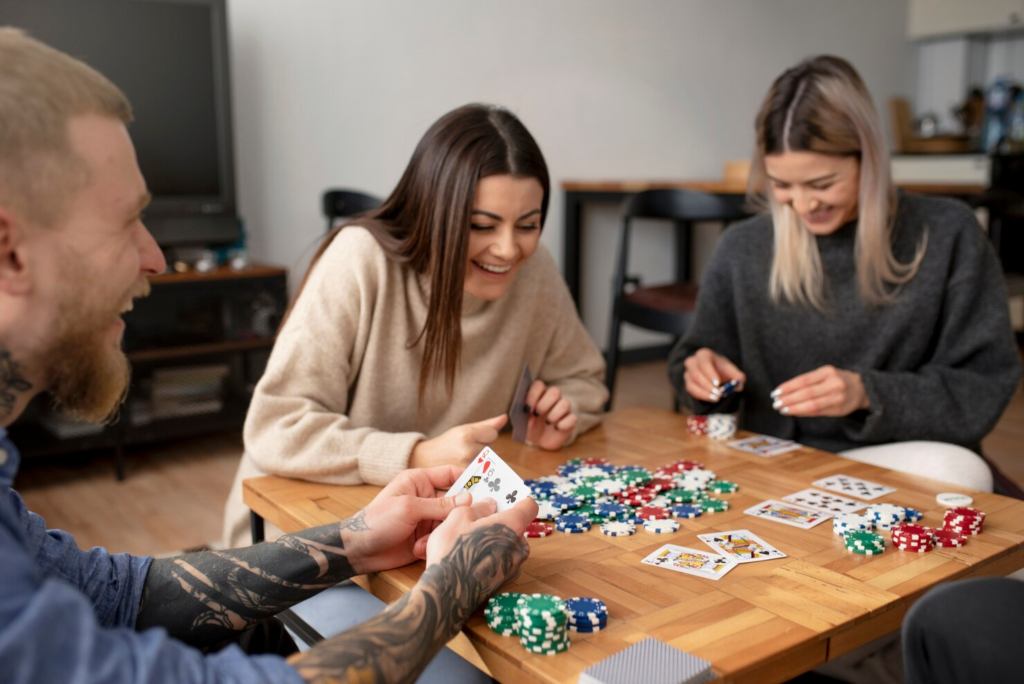
Every hand of cards or board game session is a mini-simulation of real situations. Decision-making, risk management, and reading people – all this gets practiced at the gaming table. We figure out which skills transfer from games to everyday life.
Poker – Risk Management and Reading People
Poker is a compressed model of decision-making under uncertainty. You don’t know your opponent’s cards, but you must act. Playing poker is built on a balance between aggression and caution, mathematics and psychology.
How to play poker smartly? You need to analyze opponents’ behavior patterns, calculate pot odds, and manage emotions. A set of cards in the game is memorized quickly, but real strength lies in reading the whole situation. Poker combinations give the foundation, and experience teaches you to see when a person is bluffing versus holding a strong hand.
What Poker Transfers to Life
Poker trains skills that work beyond the gaming table:
- Making decisions with incomplete information.
- Controlling emotions under pressure.
- Long-term strategy planning.
- Evaluating risks and potential rewards.
Players learn to separate result from decision quality. You can do everything right and still lose – such is the nature of probabilities.
Go – Intuition and Balance Between Attack and Defense
Go appeared in China more than 2500 years ago. Rules are simple: two players place black and white stones on a 19×19 board, surrounding the opponent’s territory. But behind simplicity hides incredible depth.
Online poker and other digital formats of classic games provide access to practice anytime. Platforms like https://pokerplanetsin.com/ are suitable for working out strategies. Poker training is built on analyzing mistakes – each lost hand shows weak spots. Online poker for money adds a price to each decision, which teaches weighing risks more precisely.
Go teaches seeing the whole picture, not fixating on details. In a game, it’s impossible to calculate all variants – intuition is needed. This skill is critical in business, where you have to act without complete data. The game strikes a balance between local battles and global strategy.
Diplomacy – Negotiations and Alliance Formation
Diplomacy is a board game where seven players control European powers of the early 20th century. Victory depends not on dice, but on the ability to negotiate, bluff, and betray at the right moment. Key lessons from Diplomacy:
- Words are cheap – promises work only while beneficial to both sides.
- Trust builds for years, collapses instantly – one betrayal destroys reputation.
- Temporary alliances are more effective than permanent ones – flexibility matters more than loyalty.
The game shows the mechanics of politics and business in pure form. There’s no room for sentiment here – only calculation and strategy.
Digital Platforms and Managing Risk
Online game formats expanded access to various forms of entertainment. Resources like Gcash games show how risk works in a digital environment. It’s important to understand boundaries here: entertainment shouldn’t turn into addiction. Games of chance teach one critical rule: mathematics works against the player over distance. This principle applies more broadly: if the system is built against you, you need to change the system, not hope for luck.
Games as a Simulator for Real Skills
Games provide a safe space for mistakes. Lost a game – extracted a lesson without real losses. This experience teaches analyzing failures, correcting the approach, and moving forward. Strategic games develop cognitive functions faster than traditional learning methods. Psychologist Annie Duke, in the book “Thinking in Bets,” analyzes how poker teaches decision-making in business and life. Her research shows that players better evaluate probabilities and manage risks in real situations. In life, such practice costs dearly; in games, nothing.
